The Things That Didn't Fit in the Suitcase
Short story about the love and beauty waiting quietly at home.
For forty years, Leon was a travel photographer.
He photographed the northern lights in Norway, the sunrise over the temples of Angkor, the tribes of the Amazon and the endless deserts of Namibia.
His pictures appeared in the most important magazines in the world. People would stand before his photographs and whisper, "What an amazing life."
But Leon had one problem.
He never once felt that the next picture would be the last one he needed to take.
There was always more light to catch, another landscape to discover, another rare moment he hadn't yet seen.
At sixty-eight, he received a message from his sister.
"Dad hardly recognizes anyone anymore. You should come."
Leon went back to the small town of his childhood, to the house where he grew up.
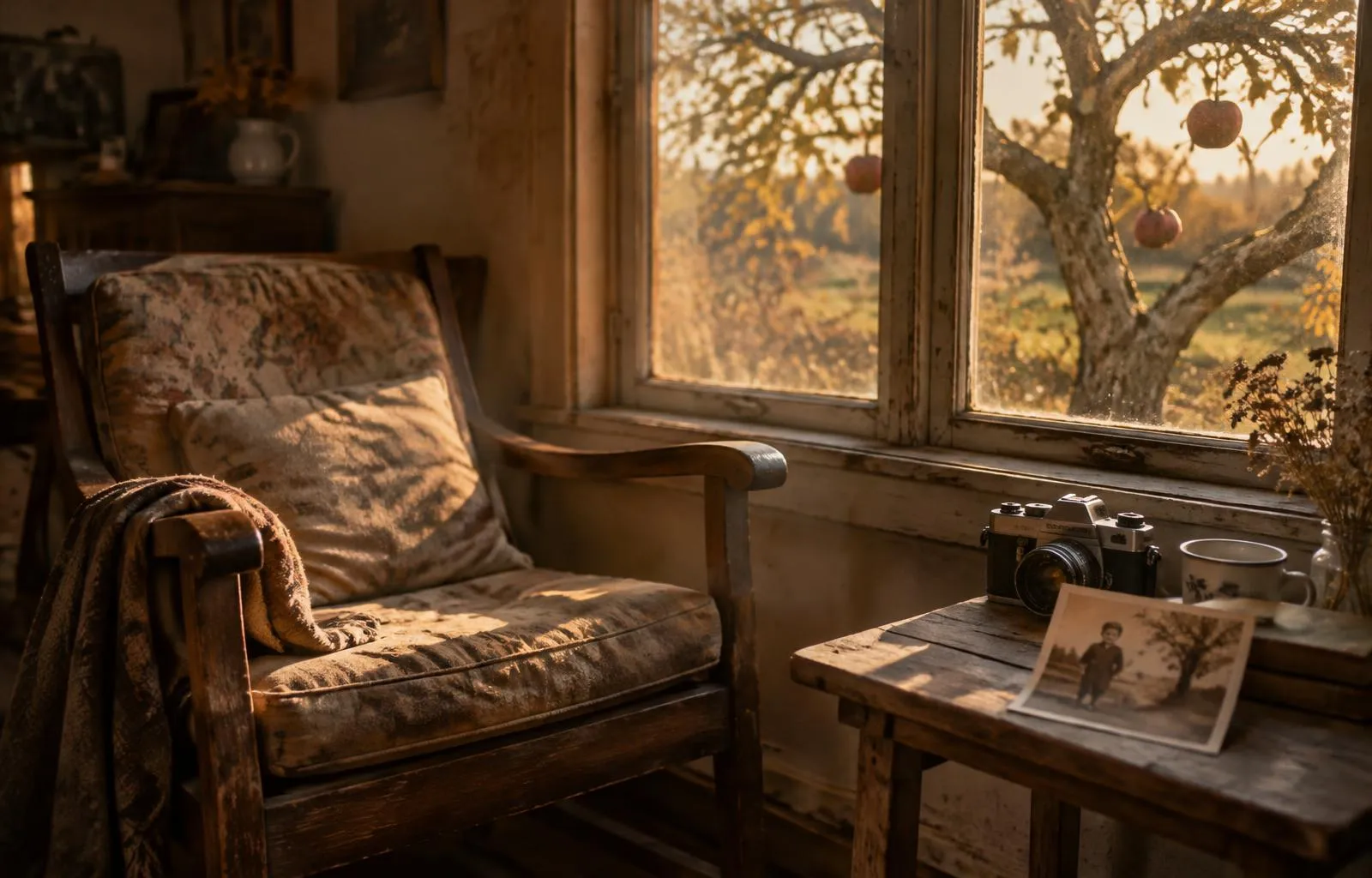
His father was sitting in an armchair by the window, gazing at an old apple tree in the yard.
"Hello, Dad."
The old man turned toward him.
"Are you the photographer?" he asked.
Leon felt something catch in his chest.
"Yes, Dad. I'm the photographer."
"Good," the old man smiled. "I wanted to ask you to take a picture of something."
"What would you like me to photograph?"
His father pointed at the tree.
"That."
Leon looked outside. An ordinary apple tree. Crooked branches, yellowing leaves, three apples left over from the summer.
"Why that one?"
"I don't remember," his father said quietly. "But every time I look at it, I feel that someone loved me very much."
Leon froze.
He remembered.
His mother had planted the tree on the day he was born. Every year, on his birthday, she would photograph him standing beside its trunk, to see how much they had both grown.
When he was seventeen, she died.
Leon left home two years later.
He had never photographed the tree.
That evening, he took out his expensive camera, pointed it toward the window and waited for the right light.
But the sun went down, and the light wasn't especially beautiful.
The next day, it rained.
On the third day, the sky was gray.
On the fourth day, when he came into the room, he found his father asleep in the armchair. His hand rested on the windowsill, as if he had been trying to touch the tree from far away.
Leon raised the camera.
Then he lowered it.
He sat down beside his father, took his hand, and stayed there.
A few minutes later, the old man opened his eyes.
"You're still here?" he asked.
"Yes, Dad."
"How lovely," the old man whispered.
It was the last time they spoke.
A month later, while Leon was sorting through his father's belongings, he found an old shoebox.
Inside were dozens of photographs.
In every one, the same boy stood beside the same tree.
On the back of the last one, taken when he was seventeen, his father had written:
"Leon is already taller than the tree. Soon he'll go out to see the world. I hope he knows he will always have somewhere to come home to."
Leon sat on the floor and wept.
He thought of the thousands of sunsets he had chased, the mountains he had crossed and the oceans he had seen.
And of one man who had sat by a window for forty years, waiting for him.
From that day on, he hardly ever photographed landscapes again.
But on his desk stood a single photograph.
A simple apple tree.
And beside it, an empty armchair.
You can see the whole world and still miss the one waiting for you at home. Sometimes the most important journey is not to a place we have never seen, but back to something we never learned to see.
Lao Tzu, Tao Te Ching, Chapter 47
“Without going out of the door, one can know the world. Without looking through the window, one can see the Way of Heaven. The farther one travels, the less one knows.”
The quoted passage is a free translation of Chapter 47 of the Tao Te Ching, attributed to Lao Tzu; wording varies between translations. This is an original fictional story by Ohananda. Leon, his father and the apple tree are literary creations; this is not an ancient Taoist story or a historical account, and the dialogue is not a quotation from Lao Tzu.
In Chapter 47 of the Tao Te Ching, Lao Tzu turns our instinct to search far away on its head: deep understanding is not collected like landscapes, mile after mile. It reveals itself when we are able to see what is already in front of us.
This is not a rejection of travel, curiosity or faraway beauty. It is an invitation to another kind of seeing: not one more rare view, but attention to what has become so familiar that the eye no longer stops on it.
Questions & answers
+What is the message of "The Things That Didn't Fit in the Suitcase"?
In Chapter 47 of the Tao Te Ching, Lao Tzu turns our instinct to search far away on its head: deep understanding is not collected like landscapes, mile after mile. It reveals itself when we are able to see what is already in front of us.
+Is this a true story?
The quoted passage is a free translation of Chapter 47 of the Tao Te Ching, attributed to Lao Tzu; wording varies between translations. This is an original fictional story by Ohananda. Leon, his father and the apple tree are literary creations; this is not an ancient Taoist story or a historical account, and the dialogue is not a quotation from Lao Tzu.
+Which wisdom tradition inspired this story?
Tao Te Ching — Lao Tzu, Tao Te Ching, Chapter 47. The strength of what yields.
Who or what has been so close to you for so long that you've stopped noticing its beauty?