The Violin That Never Played
Short story about what remains in our hands, even when they can no longer build.
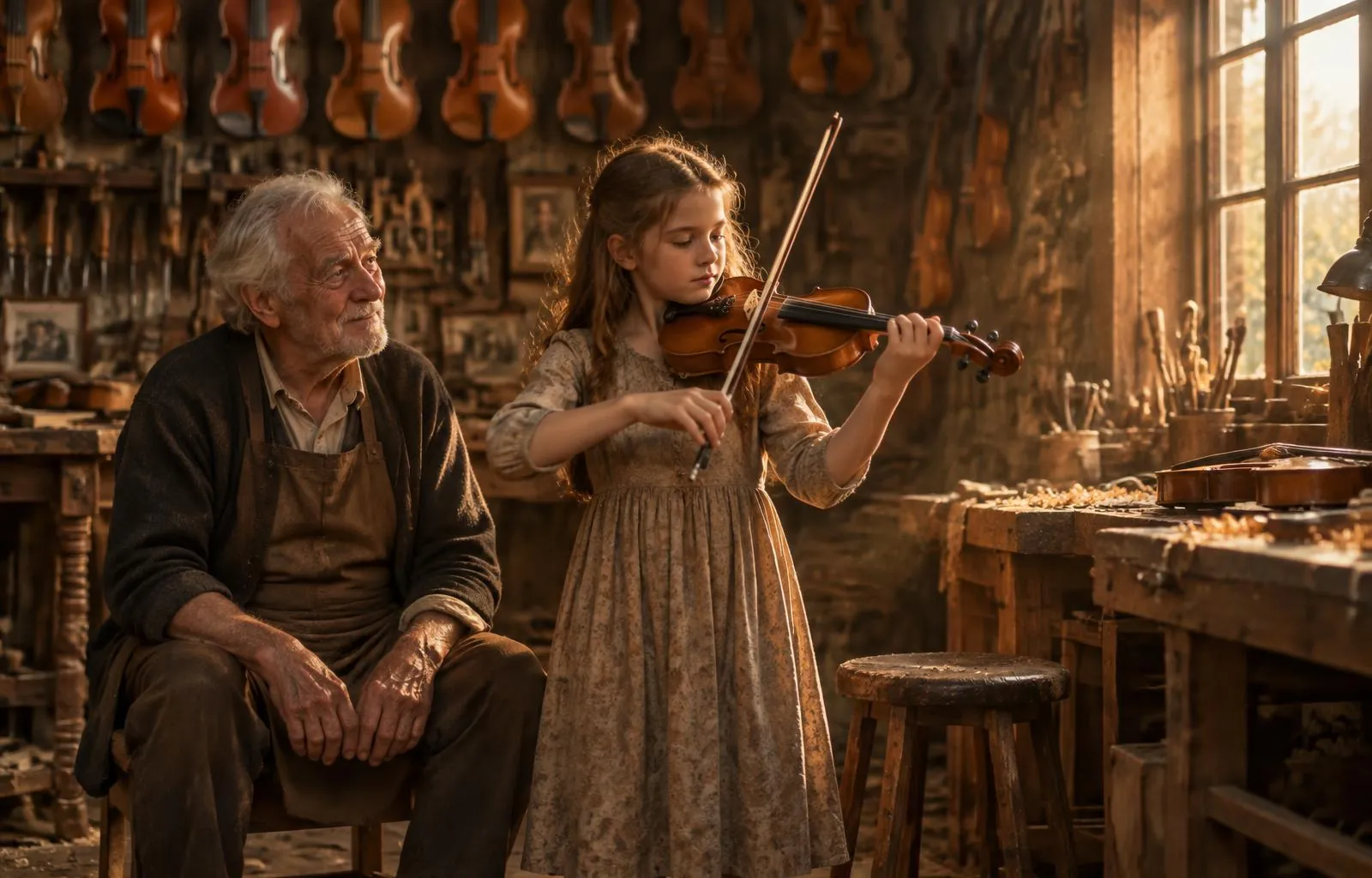
For forty years, Alexander made violins.
He could recognize good wood by the sound it made when he tapped it. He could feel with his fingertips when the strings were tightened just right.
But more than anything, he loved the moment someone played a violin he had finished making.
One day, his hands began to tremble.
A little at first. Then more.
The doctor told him the trembling was unlikely to go away.
Alexander tried to keep working. He broke two violins, cut his finger, and eventually closed his workshop.
For months, he couldn't bring himself to enter it.
One morning, his granddaughter Emma arrived carrying an old violin she'd found in a closet.
"Grandpa, will you teach me to play?"
"I can't do what I used to do anymore," he replied.
"But I didn't ask you to make me a violin."
He looked at her.
"Just teach me how to make it sing."
Alexander smiled sadly. Then he took the violin, placed it in her hands, and showed her how to hold the bow.
The first note sounded terrible.
Emma burst out laughing.
So did he.
Over the following weeks, they met every Thursday. He taught her to listen, to feel, to find beauty even in an imperfect sound.
One evening, halfway through a simple melody, Emma stopped.
"Grandpa, why are you crying?"
He wiped his eyes.
"Because I thought I'd lost the music."
"But it's right here," she said, lifting the violin.
Alexander looked at his trembling hands, then at his granddaughter.
For months, he had mourned the hands he no longer had.
Only now did he realize how much love they still held.
He never returned to making violins.
But every Thursday, when music filled the house, he felt that it had never truly left him.
Sometimes life takes away the way we once knew how to give something to the world. That doesn't mean it has taken away what we still have to give.
Epictetus, Enchiridion 1; Marcus Aurelius, Meditations
An original, fictional Ohananda story inspired by Epictetus and Marcus Aurelius on the distinction between what is and is not within our control. Alexander and Emma are fictional; this is not an ancient Stoic parable or a historical account.
Inspired by Stoic wisdom: we cannot always choose what life takes from us, but we can choose what we do with what remains.
The story draws on the teachings of Epictetus and Marcus Aurelius, particularly the distinction between external circumstances we cannot control and the choices, character, and actions that remain available to us.
Questions & answers
+What is the message of "The Violin That Never Played"?
Inspired by Stoic wisdom: we cannot always choose what life takes from us, but we can choose what we do with what remains.
+Is this a true story?
An original, fictional Ohananda story inspired by Epictetus and Marcus Aurelius on the distinction between what is and is not within our control. Alexander and Emma are fictional; this is not an ancient Stoic parable or a historical account.
+Which wisdom tradition inspired this story?
Stoicism — Epictetus, Enchiridion 1; Marcus Aurelius, Meditations. Freedom through what depends on us.
What are you mourning today that may still be in your hands, in another form?