The Woman Who Carried Fire
Short story about loving without a transaction.
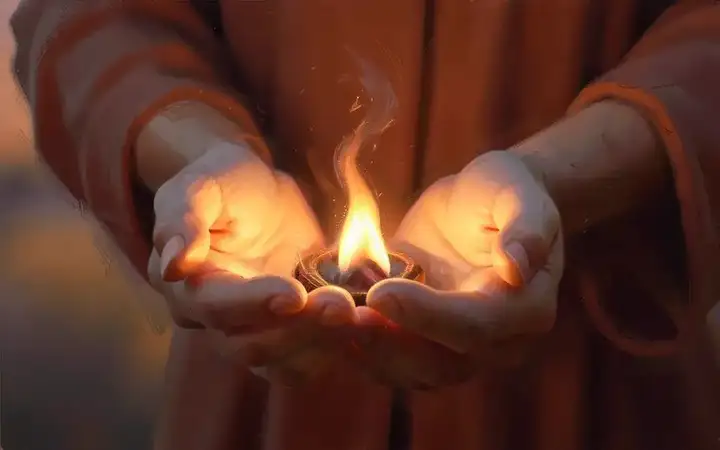
They saw her at dusk, walking fast through the market with a lit torch in one hand and a jug of water in the other, not looking at anyone.
Someone finally called out to ask where on earth she was going with those.
"To burn down paradise," she said, without slowing down, "and to put out the fires of hell."
This was Rabia. A young man, curious despite himself, ran to catch up with her. "Why would you do that?"
"Because they are in the way."
She stopped and turned to look at him properly for the first time. "You pray. Why?"
He had been well taught, and answered the way he'd been taught to answer: for the reward of paradise, and to be spared the punishment of hell.
"Then you are a faithful servant of your own comfort, not of God." She lifted the torch a little higher, so it lit both their faces. "While there is a paradise to be won and a hell to fear, no one — not you, not the greatest scholar in this city — will ever really know whether they love God, or simply love their own future." She nodded at the torch and the jug. "So. Burn the one, drown the other. Then let's see who is still praying, and why."
He told that story for the rest of his life, and always said the frightening part was never the fire. It was that walking home afterward, in the dark, he tried honestly to name one single thing he had ever done for no return at all — and couldn't find one.
Love with terms attached is an arrangement. It is worth knowing which one you have.
Traditional accounts of Rabia al-Basri (d. 801 CE)
The torch-and-water saying is attributed to Rabia al-Basri in later hagiographies, notably Attar's Memorial of the Saints; it is traditional material rather than a documented quotation. The young man and the street are Ohananda's additions.
Rabia of Basra, an eighth-century mystic, is remembered for insisting on love without hope of reward and without fear of punishment — a demand so severe it reshaped Sufi devotion after her.
Her question is uncomfortable in any age: is this love, or is it an arrangement dressed up as devotion? Most of us discover, if we're honest, that our generosity has quiet terms attached. The tradition does not treat that discovery as damning. It treats it as the starting point of real love, not the end of it.
Questions & answers
+What is the message of "The Woman Who Carried Fire"?
Love with terms attached is an arrangement. It is worth knowing which one you have. Rabia of Basra, an eighth-century mystic, is remembered for insisting on love without hope of reward and without fear of punishment — a demand so severe it reshaped Sufi devotion after her. Her question is uncomfortable in any age: is this love, or is it an arrangement dressed up as devotion? Most of us discover, if we're honest, that our generosity has quiet terms attached. The tradition does not treat that discovery as damning. It treats it as the starting point of real love, not the end of it.
+Is this a true story?
The torch-and-water saying is attributed to Rabia al-Basri in later hagiographies, notably Attar's Memorial of the Saints; it is traditional material rather than a documented quotation. The young man and the street are Ohananda's additions.
+Which wisdom tradition inspired this story?
Sufism — Traditional accounts of Rabia al-Basri (d. 801 CE). The path of the lover.
When did you last do something with no possible return?