The Light No One Could Extinguish
Short story about inner light and the worth that does not depend on what we can do.
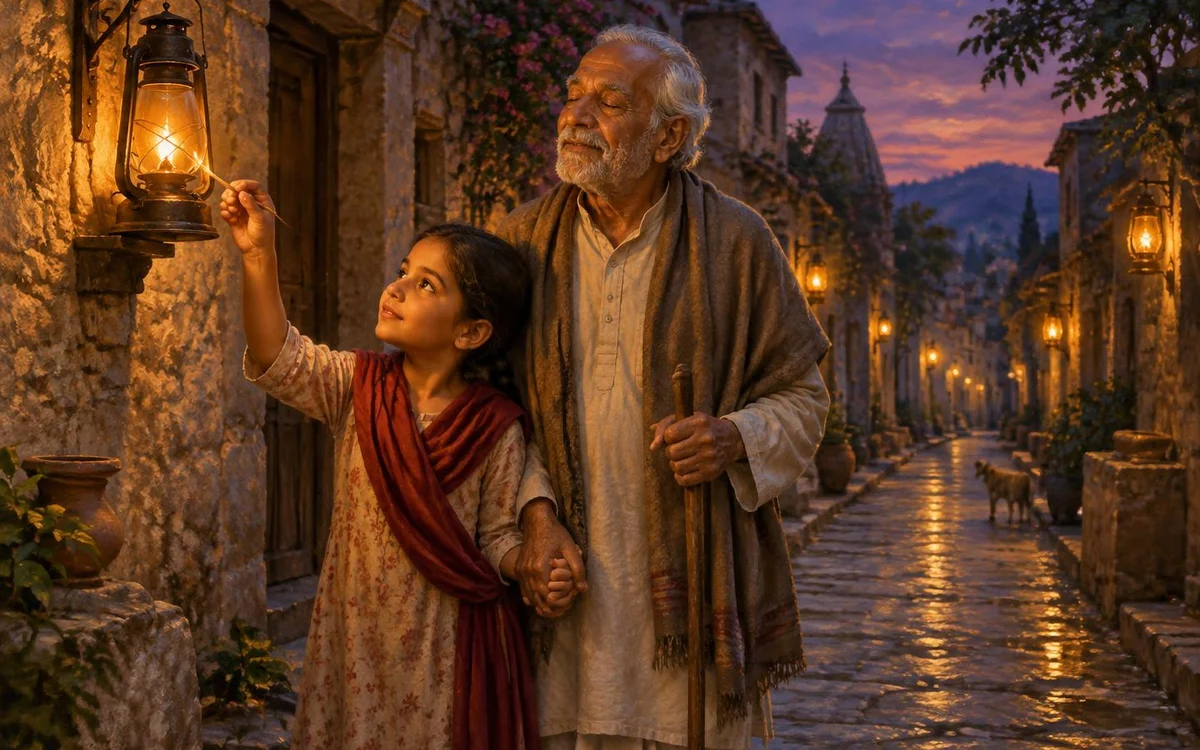
In a small village in northern India lived a man named Ravi, who lit the street lanterns every evening.
For forty years, he had left his home as darkness fell, carrying a small ladder and a jug of oil, making his way from lantern to lantern through the village lanes.
The villagers loved him.
The children would run after him, calling, "Ravi, light ours too!"
And he would smile and say:
"Do not be afraid of the dark. There is always a light we can kindle."
But one day, Ravi began to lose his sight.
At first, he struggled to see things in the distance. Then he could no longer make out people's faces. And finally, within a few months, his whole world became darkness.
The doctors said he would never see again.
Ravi shut himself away at home.
He, who had devoted his life to bringing light to others, could no longer see even the sunlight.
One evening, his little granddaughter, Anya, came to visit.
"Grandfather, why don't you go outside anymore?"
"Because I have nothing left to give the world," he replied.
"That isn't true," she said.
Ravi smiled sadly. "Once, I was the man who lit the lights. Now I don't even know whether it is day or night."
Anya was quiet for a moment.
Then she asked:
"Grandfather, when you dream at night, do you see things?"
"Sometimes," he replied. "I see the river, the house where I grew up, and even your grandmother when she was young."
"But your eyes are closed when you dream, aren't they?"
"They are."
"Then how do you see?"
Ravi fell silent.
The girl went on.
"And when you remember Grandmother's face, do you see her?"
"Yes," he whispered.
"But your eyes aren't seeing her now."
"No."
"Then perhaps there is a light inside you that doesn't need eyes?"
Ravi felt as though someone had opened a small window in his heart.
The next day, he asked Anya to lead him to the old temple at the edge of the village.
There he met an elderly monk who had known him since childhood.
"Ravi!" the monk called. "It has been so long since I saw you."
"Since I saw you, too," Ravi replied, and they both laughed.
Then Ravi told him about Anya's question.
The monk listened quietly.
At last, he asked:
"Ravi, when the sun sets, by what light do you see?"
"By the light of the lamps," he replied.
"And when the lamps go out?"
"I find my way by sound."
"And when there is no sound, and you sit alone in silence?"
Ravi thought.
"I still know that I am here."
The monk smiled.
"And what lights that knowing?"
Ravi did not answer.
The monk continued:
"There is a light that allows the eyes to see. And there is a light by which you know that you are seeing, hearing, dreaming, remembering, and even hurting."
He placed a hand on Ravi's shoulder.
"The first light can go out. The second is not a lamp."
Tears filled Ravi's blind eyes.
"Then," he whispered, "I have not lost all the light."
"No," the monk replied. "But perhaps now you can come to know a light you had not noticed before."
That evening, Ravi asked his granddaughter to bring him his old jug of oil.
"Grandfather, do you want to light the lanterns?"
"No," he said. "I want you to teach me how."
And so the two of them began going out into the village lanes every evening.
Anya climbed the ladder and lit the lanterns, while Ravi stood below and guided her.
Along the way, they would stop at houses, talk with lonely people, listen to their stories, and sometimes simply sit with them in silence.
Little by little, the villagers began to say that the evenings had become more beautiful than they had ever been.
Years later, when Anya was already a young woman, she asked her grandfather:
"Grandfather, what was the hardest thing about losing your sight?"
Ravi thought for a long moment.
"Believing that without it, I was no longer who I had been."
"And what did you discover?"
He held her hand.
"That all my life, I thought I was the man who brought light into the world."
He smiled.
"Only when my world grew dark did I discover that I never needed to create the light. I only needed to let it shine through me."
At that moment, the last lantern in the lane was lit.
Ravi did not see it.
But he heard Anya's laughter, felt her hand in his, and knew that the evening was beautiful.
Even when life grows dark, it does not mean the light within us has gone out.
Brihadaranyaka Upanishad 4.3.1–6; Katha Upanishad 2.2.15
This is an original story inspired by the Upanishads. The characters and events are fictional, and the emotional interpretation is a literary adaptation of ancient philosophical ideas.
The story draws inspiration from a profound dialogue in the Brihadaranyaka Upanishad (4.3.1–6), in which the sage Yajnavalkya is asked what light guides a person.
First, he answers: the sun. Then the moon, fire, and sound. But when all external lights are unavailable, he points to the Self, Atman, as a person's light.
A similar idea appears in the Katha Upanishad (2.2.15):
"There the sun does not shine, nor the moon and stars... By its light, all is illuminated."
The light here is not physical light, but a metaphor for the consciousness through which we are aware of every experience.
Questions & answers
+What is the message of "The Light No One Could Extinguish"?
Ravi discovers that losing his sight does not erase his worth or his ability to be present for others. Inner light is a metaphor for consciousness, not physical vision or supernatural illumination. The monk's dialogue is fictional; the Katha Upanishad excerpt is an abridged literary translation, not a Sanskrit quotation.
+Is this a true story?
This is an original story inspired by the Upanishads. The characters and events are fictional, and the emotional interpretation is a literary adaptation of ancient philosophical ideas.
+Which wisdom tradition inspired this story?
Upanishads — Brihadaranyaka Upanishad 4.3.1–6; Katha Upanishad 2.2.15. The turn inward.
Sometimes life takes away something we believed was an inseparable part of who we are.
An ability. A role. A relationship. A dream.
And the pain is real.
Yet perhaps, beneath everything we can do or lose, something deeper remains.
Our worth comes not only from what we are able to do, but also from our very presence in the world.