The Man Who Held the Rain
Short story about doing what must be done, and learning to live without knowing.
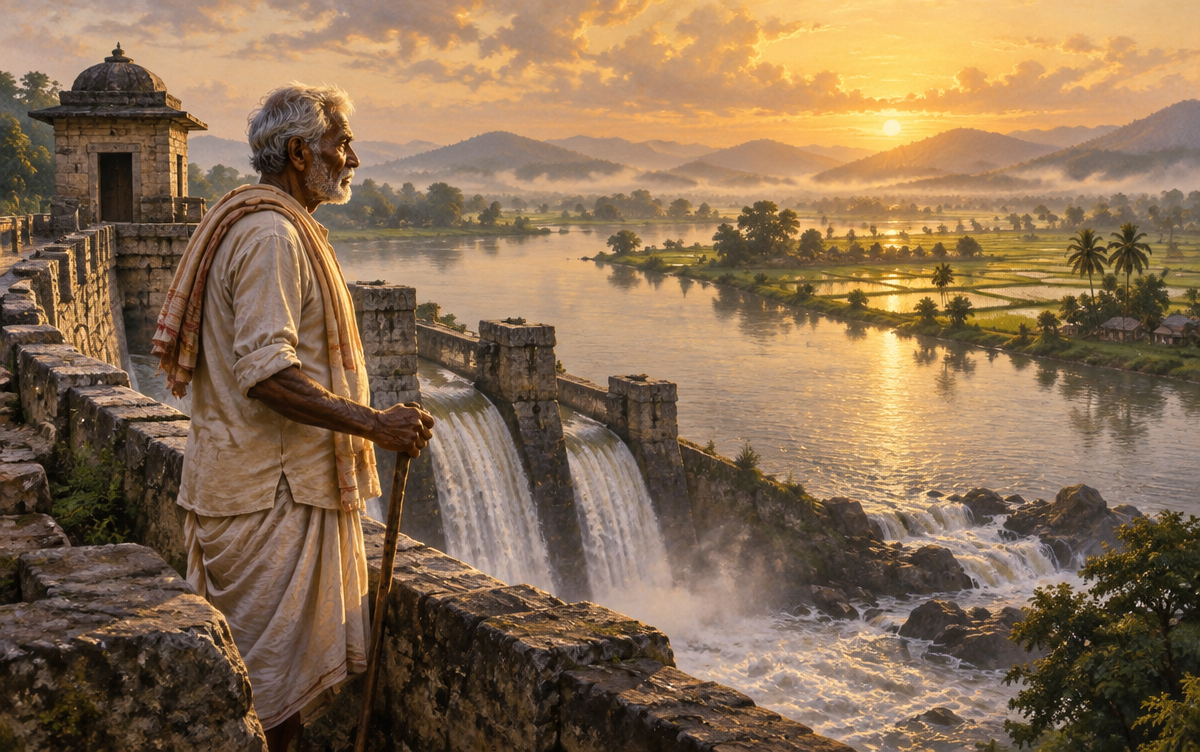
For thirty-seven years, Ravi was responsible for the dam above the village.
Every morning, before the sun rose, he would climb the stone steps, check the water gates, and listen to the river.
The villagers used to say: "As long as Ravi is up there, we can sleep in peace."
And he loved that sentence.
Perhaps too much.
On the night the great rain came, Ravi was alone at the dam.
The water rose faster than he had ever seen. Trees were torn from the earth, and the river roared like a wounded animal.
Ravi understood that he had to open the emergency gate.
But if he opened it, the water would flood the lower fields. A whole year's harvest would be lost.
And if he didn't, the dam might collapse and sweep the entire village away.
His hands trembled.
For thirty-seven years, he had always known what to do.
This time, he didn't.
He remembered his father, who had taught him the dam keeper's craft.
"One day," his father had told him, "you will face a decision you will never know was right."
"And what will I do then?" young Ravi asked.
His father smiled sadly.
"You will do what you must do. And then you will have to learn to live without knowing."
Ravi opened the gate.
The water burst through with tremendous force.
By dawn, the village still stood.
But the fields were ruined.
People wept at the sight of the lost harvest. One man shouted at him: "Do you know how hard we worked for this land?"
Ravi did not answer.
He went home, sat down on the floor, and did not leave it for three days.
On the fourth day, there was a knock at the door.
It was a little girl named Tara. She was holding a bowl with a little rice in it.
"Mama sent you some food," she said.
"I'm not hungry."
The girl set the bowl down beside him.
"Papa says that because of you, we lost all our rice."
Ravi lowered his eyes.
"Maybe he's right."
Tara sat down beside him quietly.
"But Grandma says that because of you, Papa is still here to be angry."
Ravi lifted his gaze to her.
The girl stood up and left.
That evening, Ravi went out of his house.
He walked to the flooded fields. People were working in the mud, trying to save seeds, repair channels, lift fallen fences.
Ravi knelt beside them and began to work.
No one thanked him.
Some didn't even look at him.
But the next day, he returned.
And the day after that.
Weeks passed.
One morning, as the sun rose over the plowed earth, the man who had shouted at him that night came over.
They worked side by side for a long time without speaking.
Finally, the man asked:
"Do you still think you did the right thing?"
Ravi drove his hoe into the earth.
"I don't know," he answered.
"And you're not afraid you were wrong?"
"Very."
"Then how do you keep going?"
Ravi looked at his mud-covered hands.
"I used to think my job was to save the harvest."
He smiled a small smile.
"Today I think my job is simply to care for people. Even when I can't save what is dear to them."
The man was silent.
Then he handed him a sack of seeds.
"Come," he said. "Let's try again."
That year, a smaller-than-usual harvest grew in the fields.
But every morning, when Ravi went out to work, he no longer asked himself whether they would forgive him.
He only asked where he was needed that day.
And for the first time in thirty-seven years, when the rain began to fall, he did not feel that he had to hold up the sky.
Perhaps peace isn't knowing we made the right choice. Perhaps it's finding the courage to keep loving, even when we may never know for certain.
Bhagavad Gita 2.47
An original fictional Ohananda story inspired by the teaching of Karma Yoga in the Bhagavad Gita. Ravi, Tara and the dam are literary creations, not an ancient account, a historical event or a quotation from scripture.
In the Bhagavad Gita, Krishna teaches Arjuna to act from deep commitment to the right path, without clinging to the fruits of the action.
"Your right is to the action alone, never to its fruits."
Bhagavad Gita, chapter 2, verse 47 (free translation).
This does not mean we don't care about the outcome. On the contrary. We do our very best, out of love, responsibility and awareness — but we understand that even when we have done everything, not everything is in our hands.
Questions & answers
+What is the message of "The Man Who Held the Rain"?
In the Bhagavad Gita, Krishna teaches Arjuna to act from deep commitment to the right path, without clinging to the fruits of the action. This does not mean we don't care about the outcome. On the contrary. We do our very best, out of love, responsibility and awareness — but we understand that even when we have done everything, not everything is in our hands.
+Is this a true story?
An original fictional Ohananda story inspired by the teaching of Karma Yoga in the Bhagavad Gita. Ravi, Tara and the dam are literary creations, not an ancient account, a historical event or a quotation from scripture.
+Which wisdom tradition inspired this story?
Bhagavad Gita — Bhagavad Gita 2.47. How to act when action feels impossible.
Where in your life are you still waiting for certainty, instead of simply doing what you must do?