The Man Who Wouldn't Put Down the Stone
Short story about carrying what no longer needs to be carried.
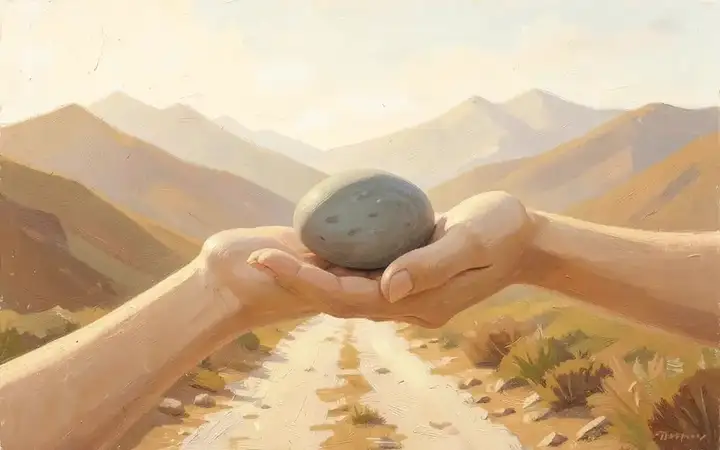
For twenty years he walked the mountain road carrying a stone.
He had picked it up on the first day, meaning to throw it at a dog that lunged at him from a ditch. The dog ran off before he could throw it. He kept the stone anyway, because the road was long and there might be other dogs.
There were no other dogs. There was only the habit of holding something.
By the fifth year his right shoulder sat lower than his left. By the tenth, people in three villages knew him by it before they knew his name: there goes the man with the stone.
When anyone asked, he said it had once saved him and might save him again. Nobody asked very often. Most people simply stopped noticing the stone, the way you stop noticing a limp.
At the river the ferryman said, "Anything heavy stays on the bank. The boat rides low enough as it is."
"I can't leave it."
"Is it valuable?"
"It's a stone."
He stood at the water's edge holding it against his hip, and for the first time in years let himself ask the real question. The dog was long dead, probably dead before he'd crossed the second village. Without the stone, what exactly was he carrying into the boat?
The answer came quiet and unflattering: nothing. He would arrive on the far bank as nobody in particular, a man with two empty hands and no story to explain his shoulder.
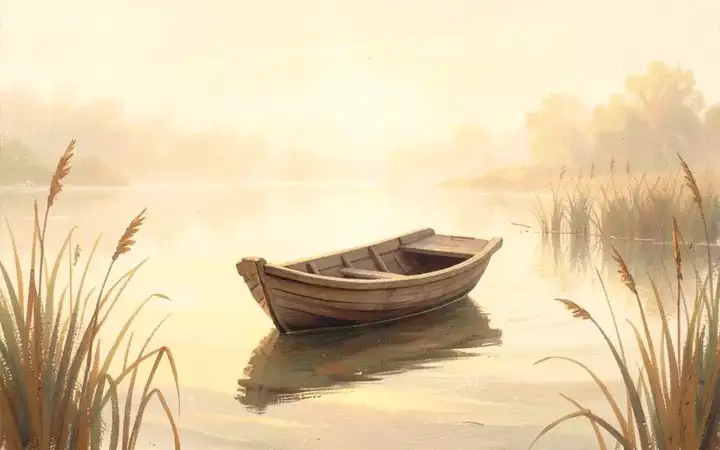
He set it down in the reeds anyway.
Halfway across the river he lifted a hand to shade his eyes from the sun, and noticed, for no reason he could name, that it cost him nothing at all.
Some things stopped protecting you long ago. You are only carrying who they made you.
Tao Te Ching, ch. 9 and 78
“Nothing in the world is softer than water, yet nothing is better at overcoming the hard and strong.”
A paraphrase of a recurring image in chapter 78; English translations vary widely. The story is Ohananda's own and is not a traditional Taoist tale.
The Tao Te Ching keeps recommending subtraction: less force, less holding, less of the identity we build around what we carry. What yields survives; what is rigid breaks.
The hardest weight to release is the one that was once genuinely useful. The reason was real — it simply expired, quietly, years before we noticed.
Questions & answers
+What is the message of "The Man Who Wouldn't Put Down the Stone"?
Some things stopped protecting you long ago. You are only carrying who they made you. The Tao Te Ching keeps recommending subtraction: less force, less holding, less of the identity we build around what we carry. What yields survives; what is rigid breaks. The hardest weight to release is the one that was once genuinely useful. The reason was real — it simply expired, quietly, years before we noticed.
+Is this a true story?
A paraphrase of a recurring image in chapter 78; English translations vary widely. The story is Ohananda's own and is not a traditional Taoist tale.
+Which wisdom tradition inspired this story?
Tao Te Ching — Tao Te Ching, ch. 9 and 78. The strength of what yields.
What are you still carrying for a reason that ended years ago?