Father's Prayer
Short story about a love that stays even when memory fades.
Every morning, at exactly five o'clock, Sanya's father would sit on the floor, close his eyes, and sing.
The same song. The same words. For forty years.
As a little girl, Sanya loved waking up to his voice.
As a teenager, she felt embarrassed when her friends heard him.
And when she grew older, she would ask him with a smile:
"Dad, do you really think God needs to hear you sing every morning?"
And he would answer, "No, my child. I'm the one who needs to sing."
When he turned seventy-eight, her father began losing his memory.
First, he forgot where he had placed his glasses. Then he forgot the names of neighbors.
One day, he forgot the way home.
Sanya moved in to care for him, watching helplessly as the man who had taught her everything she knew about life slowly drifted away.
One morning, she entered his room and found him sitting on the floor.
His eyes were closed.
His lips were moving.
But no sound came out.
"Dad?"
He opened his eyes and looked at her, confused.
"I can't remember the words."
Sanya sat beside him.
"It's okay, Dad."
"But I've sung them my whole life," he said. "How could I forget?"
He lowered his head.
"What if He forgets me too?"
Sanya felt her throat tighten.
She wanted to tell him that God would never forget him. She wanted to promise that everything would be all right.
But life had taught her that not everything could be promised.
So she simply took his hand.
And for the first time since she was a little girl, she began singing his song.
At first, softly and uncertainly.
Then louder.
Her father looked at her in surprise.
"You know this song?"
"You taught me, Dad."
He smiled.
"How lucky I am to have you."
The next morning, he no longer remembered her name.
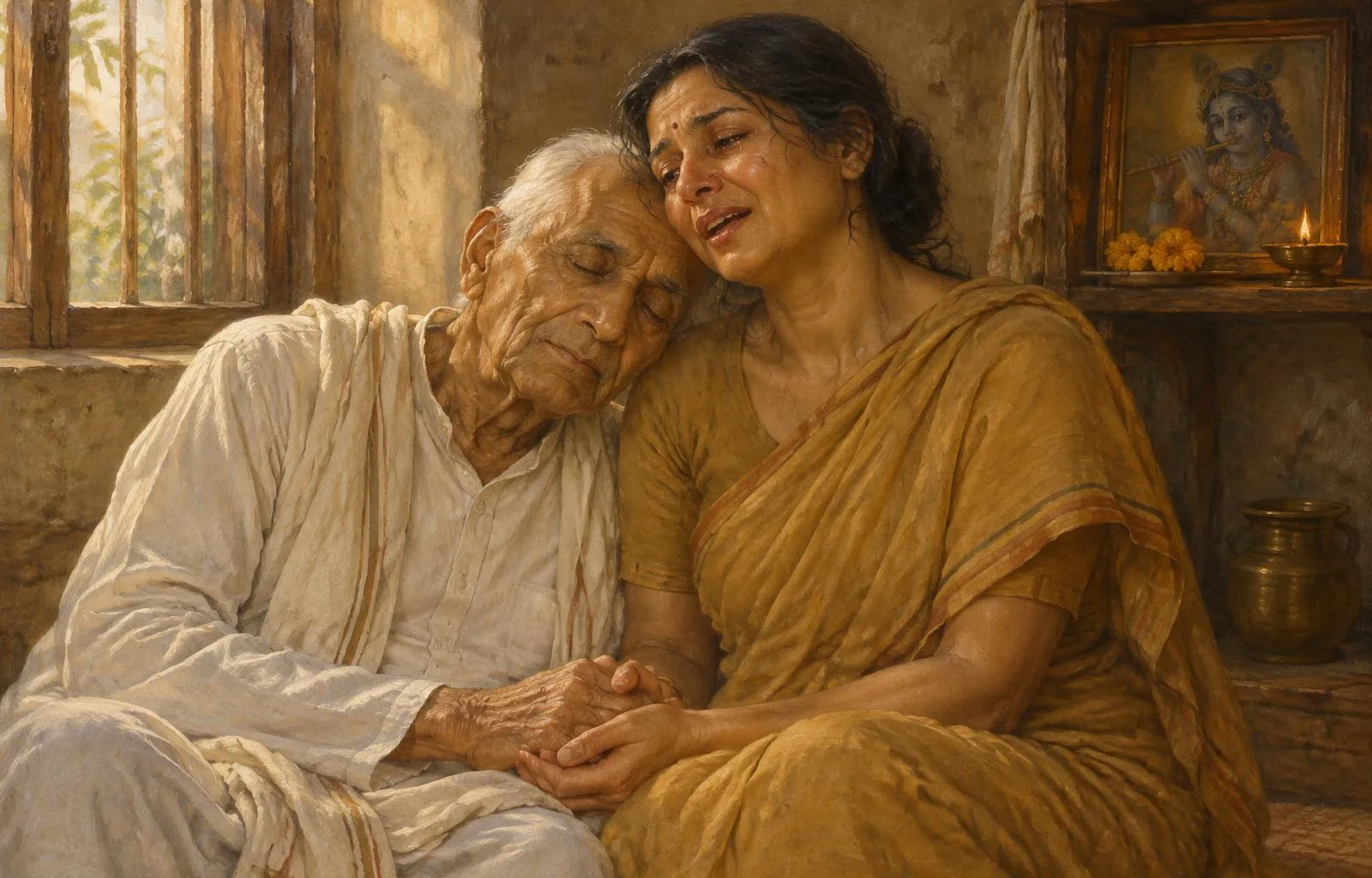
But when Sanya sat beside him and began to sing, he closed his eyes and rested his head on her shoulder.
And so they continued, every morning.
He forgot the words.
She remembered them for him.
He forgot who she was.
She remained his daughter.
Until one morning, in the middle of the song, he lifted his head and asked:
"Why do you come to see me every day?"
Sanya smiled through her tears.
"Because I love you, Dad."
He was silent for a moment.
"But I don't even know who you are."
She kissed his forehead.
"That doesn't matter. I know who you are."
And in that moment, she finally understood his old answer.
He had never sung so that God would remember him.
He sang because he loved.
And now, when he could no longer sing, that love continued through her voice.
Because true love does not ask to be remembered.
It stays, even when memory fades.
One day, someone we love may no longer remember who we are. But we can still be the place where they feel loved.
Bhakti Yoga: The Path of Love and Devotion
An original fictional Ohananda story inspired by the Bhakti tradition and the practice of Nama Smarana. Sanya, her father and their song are literary creations, not an ancient account, a historical event or a quotation from scripture.
In the Bhakti tradition, Nama Smarana is the practice of remembering the Divine through the loving repetition of sacred names. Yet the heart of the practice is not merely the words, but the devotion and love they express.
Sanya discovers that love does not depend on recognition, memory, or reciprocity. Her father can no longer give her what he once did, yet her love for him remains.
She becomes the continuation of his prayer.
Questions & answers
+What is the message of "Father's Prayer"?
In the Bhakti tradition, Nama Smarana is the practice of remembering the Divine through the loving repetition of sacred names. Yet the heart of the practice is not merely the words, but the devotion and love they express. Sanya discovers that love does not depend on recognition, memory, or reciprocity.
+Is this a true story?
An original fictional Ohananda story inspired by the Bhakti tradition and the practice of Nama Smarana. Sanya, her father and their song are literary creations, not an ancient account, a historical event or a quotation from scripture.
+Which wisdom tradition inspired this story?
Bhakti Yoga — Bhakti Yoga: The Path of Love and Devotion. Love and devotion made visible in how we meet others.
Who in your life could you be a place of love for today, without asking for anything in return?